

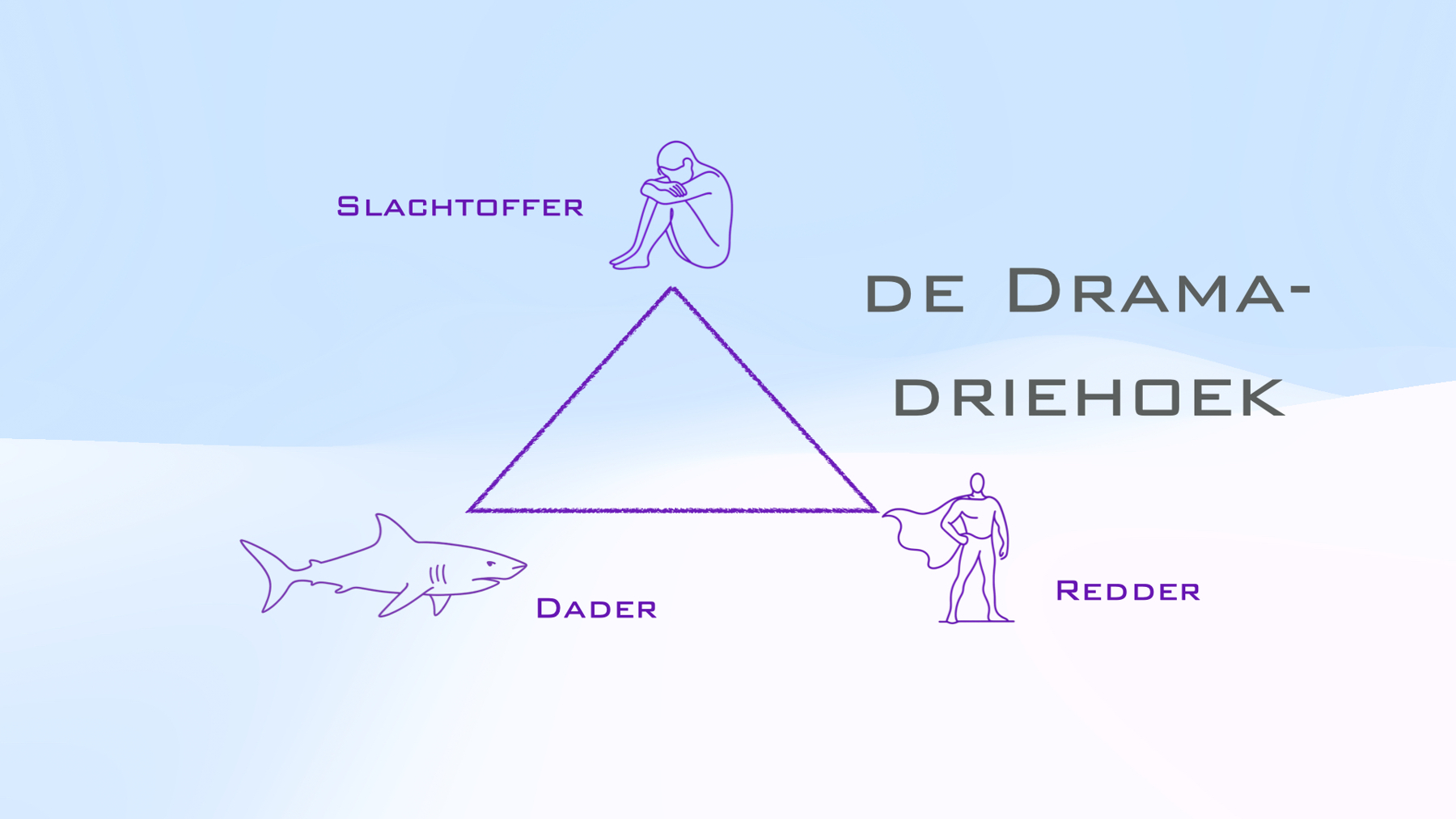
In this episode, we examine the drama triangle, a powerful psychological model developed by Stephen Karpman in the 1960s within Transactional Analysis. The model illustrates how people in conversations and conflicts often—unconsciously—step into fixed roles: Victim, Persecutor, or Rescuer.
These three roles reinforce each other and sustain the dynamic. The Victim feels powerless, evades responsibility, and points to others. The Victim can even exert power by accusing others or demanding help, making it a particularly attractive position. The Persecutor adopts an accusing or aggressive stance and operates according to the principle “I’m OK, you’re not OK.” And the Rescuer appears to act nobly by offering help, but often does so uninvited and from the conviction that the other person cannot do it themselves. In doing so, they confirm the victimhood and undermine growth and responsibility.
The power of the model lies in its relatability. Everyone has experienced situations where these three roles were present: in families, in teams, in the workplace, and in politics and society. Consider the father who feels like a victim because dinner isn’t ready, the mother who reacts as a persecutor by lashing out in anger, and then perhaps ends up in the victim role herself. Or think of discussions at work or in the media where groups present themselves as victims, label others as persecutors, and seek support from rescuers. Roles shift rapidly, causing conversations to become deadlocked and leading to polarization.
It is important to note that Karpman speaks about psychological positions, not about factual victims or perpetrators. Of course, actual victims and perpetrators exist (for example, in a crime), and there, factual rescuers like the police or emergency services are necessary. But in most daily interactions, it concerns subjective experiences: I feel like a victim, I see you as a persecutor, or I assume the role of rescuer. That insight makes the drama triangle so useful for better understanding communication.
The podcast delves deeper into the three roles:
- Victim: ranging from the dramatic lament (“poor me”), to the angry accusing variant, to learned helplessness. The great advantage of this role is that you do not have to take responsibility—you shift the blame to someone else. Typical behavior includes complaining, accusing, seeking support, or waiting passively.
- Persecutor: someone who makes reproaches, condemns, or belittles. This can be loud and aggressive, but also subtle and passive-aggressive. The conviction here is: “I'm OK, you're not.”
- Rescuer: jumps in to help from the conviction that the other person is incapable. Often well-intentioned, but the result is that the other person remains passive and relinquishes responsibility. We see this in the workplace, in parenting, and in societal debates.
A common thread throughout the episode is the question: how do you step out of the drama triangle? The answer begins with awareness. As soon as you recognize yourself in one of the three roles, you can press a pause button and consider: which value or need of mine is being affected here? By investigating that, you take responsibility for your own emotions instead of shifting them onto others.
Additionally, there are other strategies:
- With a Victim: do not rescue immediately, but ask questions (“What exactly is affecting you? What step can you take yourself?”).
- With a Persecutor: work on empathy and listen to the 'why' behind the other person's behavior.
- With a Rescuer: pull the handbrake and first check what help is actually needed, instead of automatically taking everything over.