How to achieve true transgenerational collaboration?!

Today, 21% of the labor market already consists of (the oldest members of) Generation Z. Meanwhile, the oldest working generation, the Baby Boomers, is exiting in waves. This has significant consequences, as the different generations in the workplace each view work and life in their own unique way.

These differences create friction. Managers—who often belong to an older generation due to their years of experience—find that their approach to motivating employees does not resonate with the younger generation. People react to one another based on the prejudices they hold about other generations. New perspectives clash with existing ones, and so on…

How can you, as an organization, make the switch from multigenerational (multiple generations existing side by side) to transgenerational, where the different generations:

Certainly not by focusing solely on Generation Z and rebuilding the entire organization into a Z-friendly workplace, but rather by taking all generations in the workplace into account.

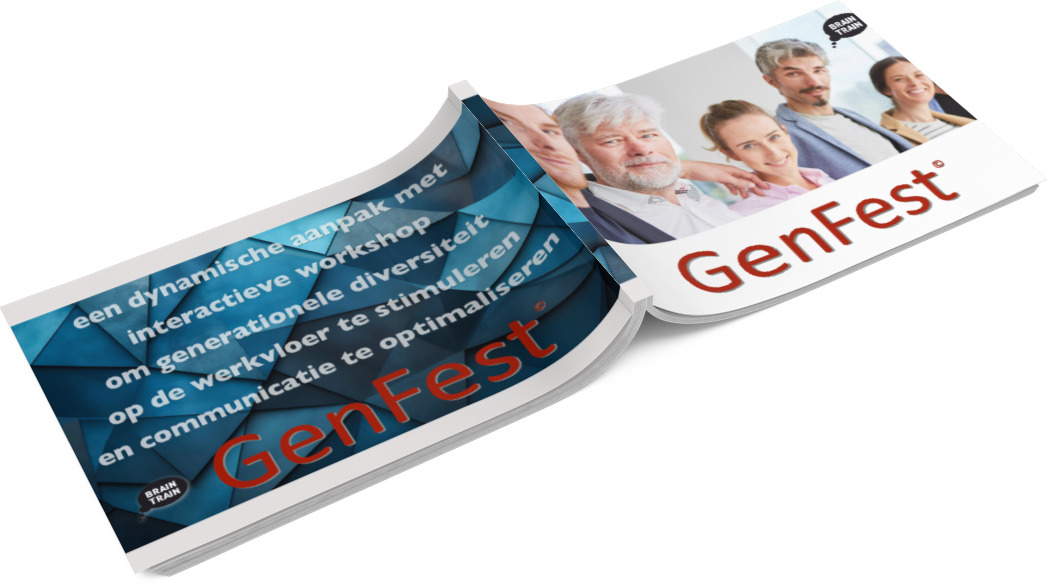
With GenFest®, we help you make that transition from multi- to transgenerational. We do this using a comprehensive toolbox of potential interventions:

If you would like to start this transition within your organization, please contact us! We would be happy to explore the possibilities that best suit your specific context.

Insights on leadership, communication, and collaboration in practice

Discover articles and videos on behavior, difficult conversations, team dynamics, and influence — with practical tools that work, even when the pressure is on.
Frequently Asked Questions

You may still have questions about how we work or what you can expect. Here, we answer the most important ones.

people
Is your question not listed?
Schedule an introduction

+32(0)486-85 15 26

Participants will approach their communication with others differently in the broadest sense of the word, even when situations become difficult or tense. They experience more calm and self-confidence, and have a better understanding of what to do instead of simply reacting to events. The difference lies in conscious action: not being at the mercy of the situation or the conversation, but engaging with it actively and curiously. The focus is on individual behavioral change, which has a visible impact on interactions with colleagues, employees, and clients. Participants often notice a difference during the training itself, which is then further reinforced through practical application.
Yes. Content, methods, language, and cases are fully tailored to the organization’s context. Where necessary, I explicitly immerse myself in the sector, the role, or the workplace itself. Context determines how people communicate and make decisions, and therefore determines how a training program is designed.
Our training programs are suitable for anyone who works with people and is willing to examine their own behavior. They are less effective when participants are under heavy pressure to attend and show no willingness to open up. We address this explicitly.
Transfer is central. We work on awareness and practice with real-life situations during the training, so that participants gain successful experiences. Where possible, we provide follow-up with participants and the client, and together we examine which contextual obstacles might hinder practical application.
The training always starts from the participants’ reality. We work with their own cases, combine reflection with practice and dialogue, and only introduce insights when they are needed. It is not a classroom-style transfer of theory or a PowerPoint-driven training.
Dealing with resistance is a core competency. We create safety and neutrality, name what is happening, and investigate the needs behind the resistance. We do not force anything, but create space so that participants can move forward again and take responsibility for their own learning process.
We always start from what is feasible within the available time. There is no fixed format: we adapt to needs, context, and workload. Where meaningful and desirable, we supplement physical sessions with preparation, digital elements, or phased trajectories to use time efficiently.
We do not work with tricks or imposed behavior. We also look “below the waterline” at beliefs, fears, and automatic patterns that block new behavior. As a result, people dare and are able to apply what they have learned outside the training, in their actual work situation.
Impact becomes visible in behavior. We work with observations from the client and participants, targeted reflection questions, and feedback during the training. Satisfaction is a starting point, but more important is whether people feel confident enough to effectively apply the new behavior.
Follow-up steps are always discussed with the client. This could be a debriefing on transfer, additional depth on specific themes, or individual coaching. The client decides what is desirable and feasible within their own context.
We are happy to think along with you about your context, challenges, and objectives. Not a standard solution, but a targeted approach that works in practice.

Schedule an intake interview

We help organizations bridge the gap between expertise and impact. Let us know how we can help you.